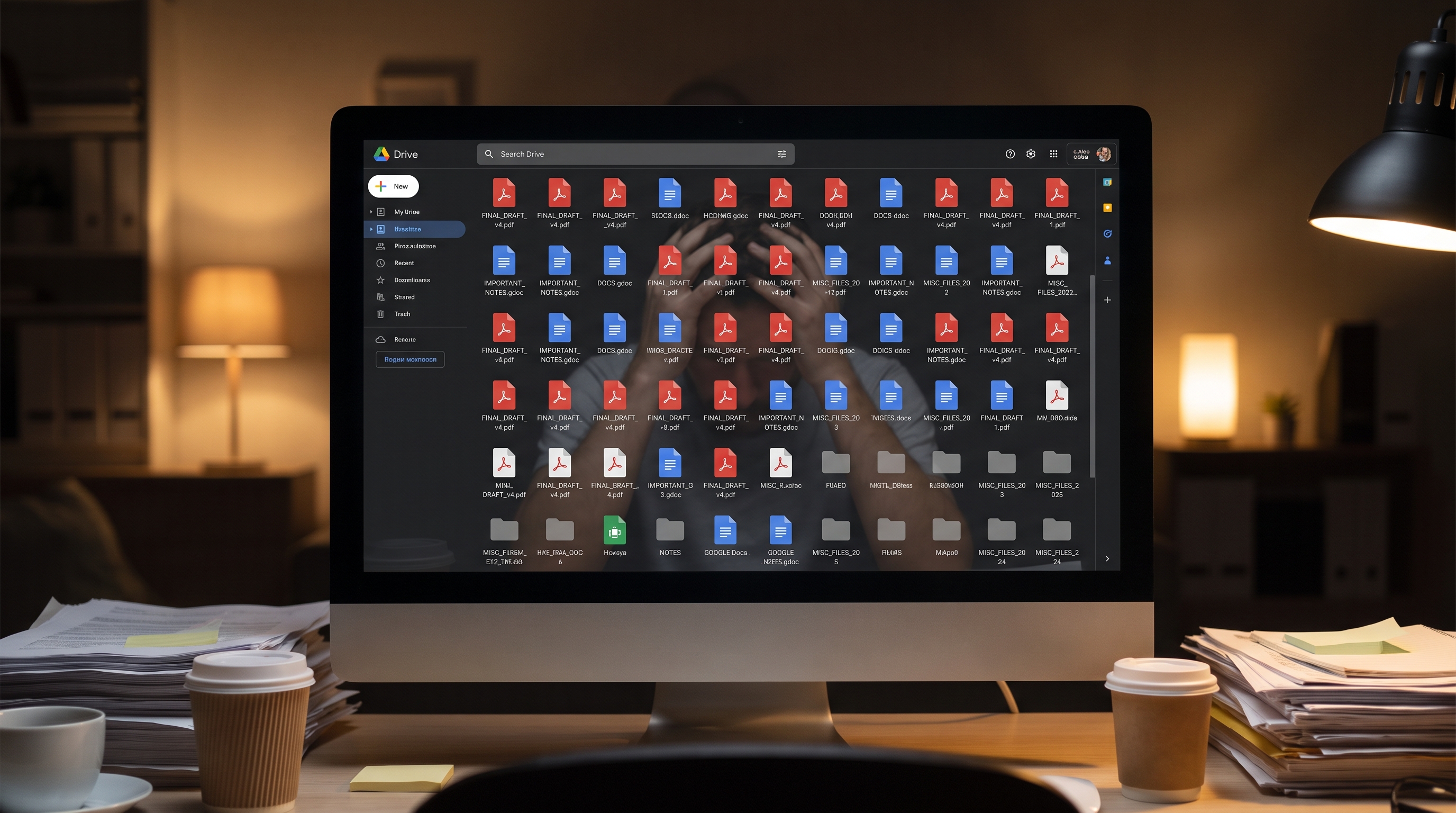
Open your Google Drive right now. Go to the folder where you keep downloaded courses, ebooks, templates, and PDFs. Count them.
Done? Good. Now ask yourself: how many of those have you actually finished? How many have you implemented? How many have generated even a single dollar of revenue for you?
If you're like the 347 people we surveyed last quarter, the answer is somewhere between zero and one. And that gap — between what you've collected and what you've used — is the most expensive thing you own.
The Inventory of Inaction
We ran a survey of 347 people who self-identified as "aspiring online entrepreneurs" — people who had purchased at least three digital courses or product bundles in the past two years. We asked them to open their cloud storage and give us real numbers.
The averages were staggering:
- 23.4 downloaded courses, ebooks, or template packs sitting in cloud storage
- 2.1 of those had been opened more than once
- 0.7 had been completed to the point of implementation
- $1,847 spent on those resources over the past 24 months
Let's do the math on that. $1,847 spent. Zero revenue generated. That's not a bad investment — that's a storage fee. You're paying to warehouse digital products you'll never use.
Average Course Graveyard
The "Already Have It" Trap
There's a specific psychological trap at work here, and it's more destructive than simple procrastination. It's the feeling that you've already done the preparation. That because you own the knowledge, you've somehow absorbed it.
Researchers call this the "illusion of competence." Owning a course about Facebook ads feels like knowing Facebook ads. Downloading a funnel template feels like having a funnel. The act of purchasing creates a sense of progress that doesn't actually exist.
We asked our survey respondents how confident they felt about starting an online business. On a scale of 1 to 10, those with 20+ unused resources averaged 4.2 — lower than people who had never purchased anything at all (averaging 5.1). The more you collect without implementing, the less confident you become.
Your Google Drive isn't a library. It's a graveyard of good intentions. And every file in it is a tiny monument to something you were going to do but didn't.
Breaking Down the Real Cost
Let's put actual numbers on the cost of inaction. We'll use the average respondent profile: 23 products purchased over 24 months, $1,847 total spend, zero revenue generated.
The direct cost
$1,847 in purchases. That's $77 per month in sunk cost. Real money, gone, with nothing to show for it.
The opportunity cost
This is where it gets painful. Among our survey respondents, we also identified a subset of 41 people who had the same profile two years ago — same number of courses, same aspirations — but who actually deployed one product during that period. Their average monthly revenue after 12 months of selling: $1,200.
That means every month you spend collecting instead of deploying, you're not just losing $77 in sunk costs. You're losing $1,200 in potential revenue. Over 12 months, that's $14,400. Over 24 months, it's $28,800.
"The most expensive folder on your computer is the one full of courses you never started. It's not just costing you what you spent — it's costing you what you could have earned."
Annual Cost of Inaction
What's Actually Missing
Here's what most people think they need to start selling online:
- A brilliant original idea
- A large social media following
- Web design skills
- Copywriting expertise
- A substantial ad budget
Here's what they actually need:
- A product that solves a specific problem (doesn't have to be original)
- A page where people can buy it
- A way to put that page in front of people
That's it. Three things. And every one of them can be set up in a single afternoon — if you have the right starting point.
The problem with the 23 courses sitting in your Google Drive is that each one teaches you a piece of the puzzle. One covers product creation. Another covers funnel building. A third covers traffic. None of them give you the whole thing in one package. So you keep collecting, hoping that eventually you'll have enough pieces to assemble something.
You won't. Because the assembly is the hard part, and no amount of courses does the assembly for you.
The DFY Solution
What if you didn't need to assemble anything? What if someone handed you a complete, ready-to-deploy business — product, sales page, email sequence, ad creative — and all you had to do was customize it and put it online?
That's the premise behind done-for-you digital product kits, and it's the single biggest reason why some beginners break through while others stay stuck in the course-collector cycle.
When you buy a DFY kit, you're not buying information. You're buying a finished product. The same way you'd buy a house instead of enrolling in a construction course. The knowledge is built in. The work is done. You just move in and make it yours.
The Full Offer
The specific kit we recommend — and the one that participants in our studies have used to generate first sales in under 30 days — is LOOT.
LOOT is a collection of 47 done-for-you digital product funnels. Each one includes:
- A complete, ready-to-sell digital product
- A conversion-optimized sales page
- A 5-email follow-up sequence
- Social media ad creative (images and copy)
You buy it once for $47. No subscription. No royalties. You keep 100% of every sale you make. Pick one of the 47 funnels, customize the headline and a few lines of copy, and you have a live, sellable product in an afternoon.
$47. One time. Compared to the $1,847 you've already spent on courses you haven't used, it might be the most rational purchase you make this year.
What Happens Next
You have two choices right now. You can close this page, go back to your Google Drive, and maybe start one of those 23 courses tomorrow. You've probably told yourself that before. Tomorrow has a way of becoming next week, then next month, then next year.
Or you can spend $47 and 4 hours this afternoon, have a live product by dinner, and join the group of people who stopped collecting and started selling.
Your Google Drive will still be there tomorrow. The question is whether you'll still be the same person who only collects — or someone who finally deployed.